

A starter guide to reading Sigrid Undset's novels
Short breakdowns and recommendations for each of her major novels

Want to start reading Sigrid Undset, but unsure where to start? This is the place for you.
I’m frightfully aware that not every person feels prepared to take on a 54 minute read (the estimated length of time for my latest post on Kristin Lavransdatter); in hopes of providing a variety of helpful tools for promoting Undset readership, here I seek to lay out short descriptions of the themes and subject matter for each of Undset’s major novels, as well as my personal recommendations. I will give similar breakdowns of Undset’s essay collections, and then later biographies about her, in later pieces. These are organized in ascending order from my least favorite (which is unfair, I absolutely love anything I’ve read by Undset, nothing has disappointed) to top favorite.
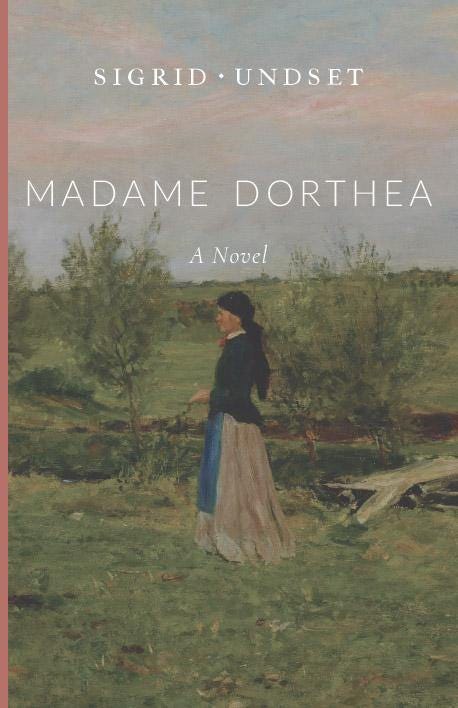
Madame Dorthea - Follows a woman navigating widowhood after the disappearance of her husband during Norway in the 1700s. I enjoyed Madame Dorthea’s portrayal of mid-18th century Norway - it’s the only novel she wrote centered in this time period, and like always the way Undset naturally incorporates the culture and reality of the time period into the story is masterful. Similarly, it’s filled with the same tender, heart-rending depictions of womanhood and motherhood that Undset so excels at. It’s a novel that just provides a short glimpse into one families life, so naturally lacks some of the epic scope and theological redemption that Undset’s other novels possess. Undset meant to write a number of sequels to it, but WWII cut those plans short.
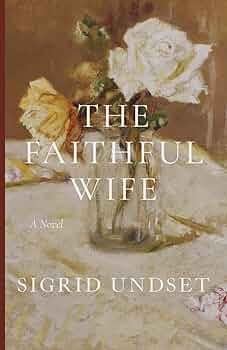
The Faithful Wife - This novel reflects on the relative value of progressive ideas vs. traditional ones within the institution of marriage, using completely irreligious characters to do so. Undset, even before her conversion, frequently wrote on themes of tradition, marriage, and progressivism, often critiquing the feminist movement while simultaneously acknowledging the reality of its concerns. In The Faithful Wife, she continues the exploration of these ideas, using her characters to bring to life the real tensions she saw in the various movements of her time. Here you’ll find glorious descriptions of the condition of women, as always, alongside lovely depictions of the Norwegian countryside. I would not recommend it as a first Undset read however, as one might miss some of the nuances of the novel unless you’re already familiar with Undset’s style.
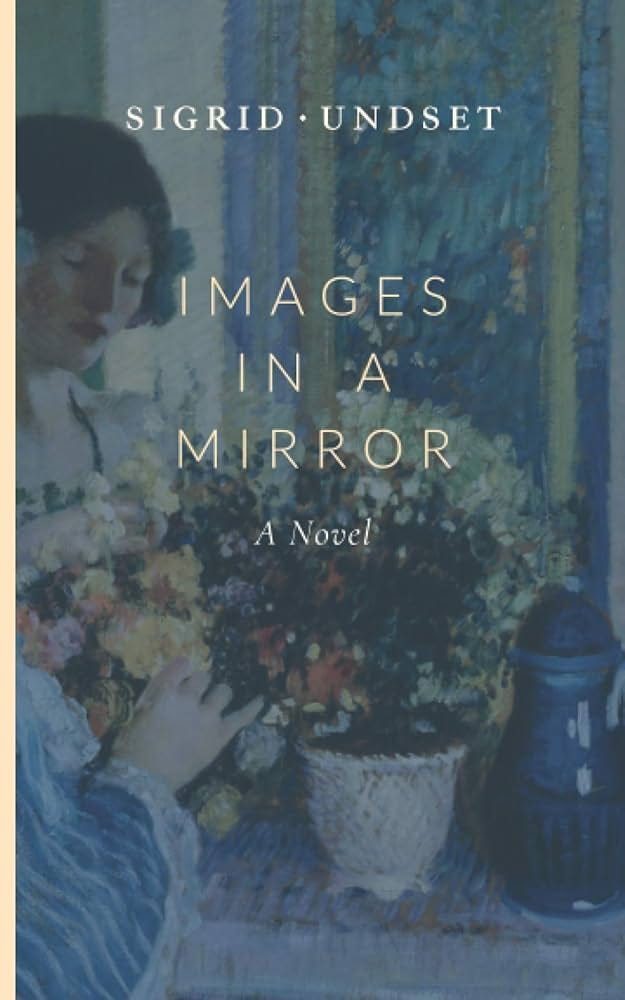
Images in a Mirror - Technically not a standalone novel, but its predecessor, Den lykkelige alder (1908; The Happy Age), has not yet been translated into English. Follows the main character Uni, mother of five, who goes through a period of intensely questioning all the what-ifs of her life, brought on by extreme exhaustion and great pining for all she once had. Highly recommend for anyone who has ever been in the depths of the postpartum period and wondered if their life would ever be easy again.
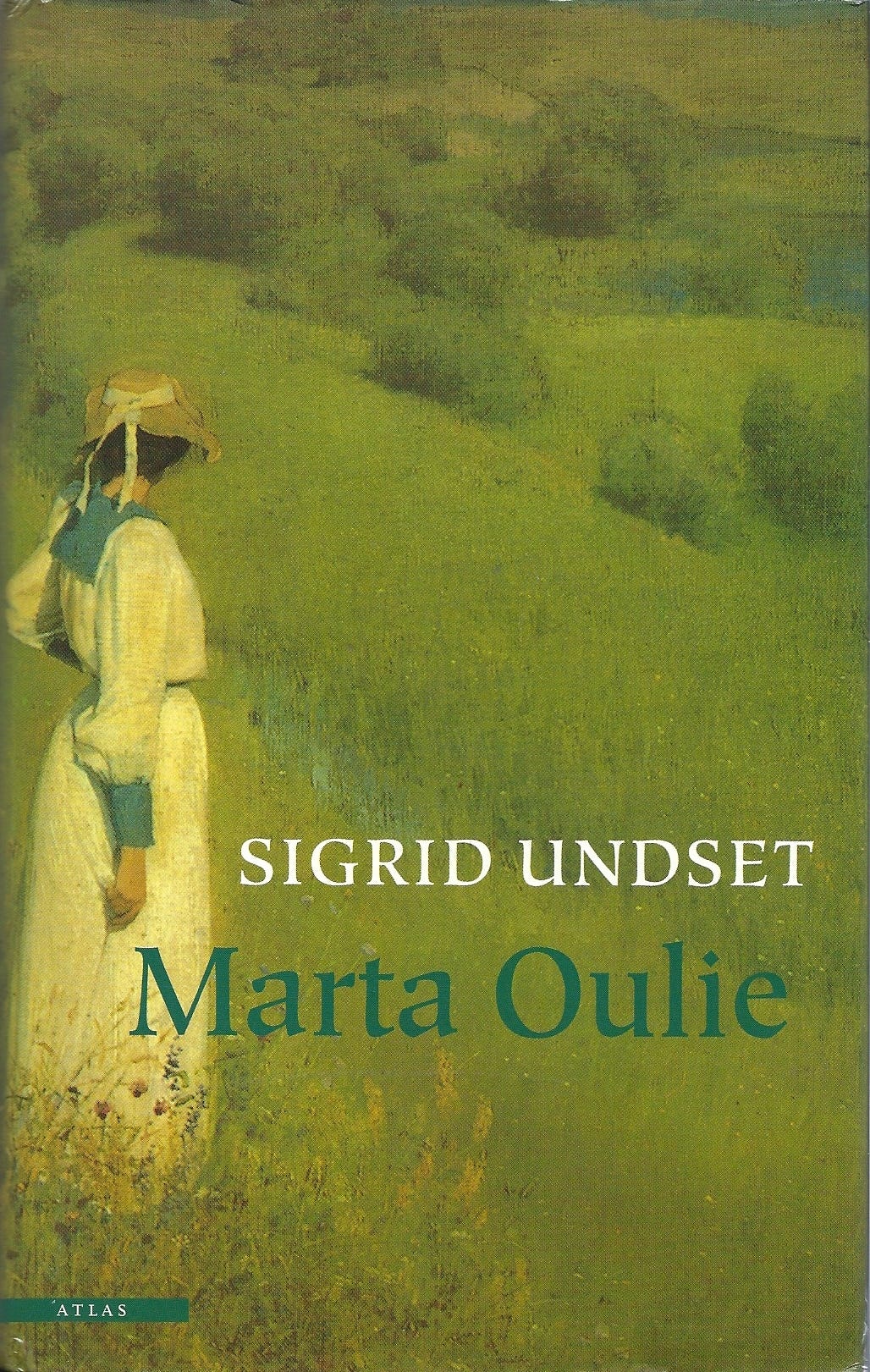
Marta Oulie - Undset’s debut novel, follows titular character Marta Oulie who has been unfaithful to her husband and grapples with it morally and emotionally. A powerful examination of how humanity can handicap itself with self-pity, and the relative merit of good intentions. One of her shorter works, a great introduction to Undset’s writing style.
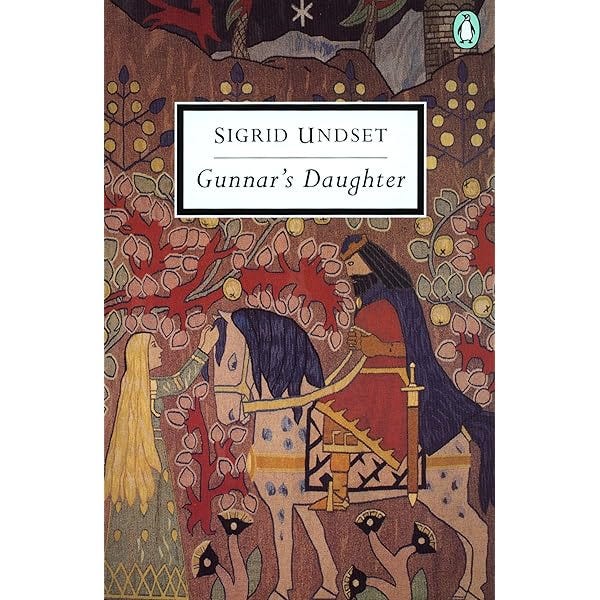
Gunnar’s Daughter - A shorter novel modeled after old Icelandic sagas, it has a unique style that clearly conveys the different setting and culture for this novel as compared to Undset’s others. Still starkly emotional, but with a degree of savagery and violence that demarcates the fact that this world is one that has only just been exposed to the first breaths of Christianity. Fascinating for its historical and cultural contributions. I would recommend for anyone interested in history and the interactions between early Christianity and pagan cultures.
The Wild Orchid + The Burning Bush - In this duology, Undset allows her theological prowess to flex, as she depicts the conversion story of young Paul Selmer to Catholicism in the early 1900s. Some critique these two books as Undset sacrificing literary finesse in order to shoehorn in Catholic theology, but I still found both novels to be beautifully written. While containing a bit less of the emotional scope commonly found in Undset's novels, nonetheless they contain powerful depictions of the colossal interior upheaval that accompanies such a shift in worldview. They can also be viewed as a personal manifesto from Undset depicting the process of her own intellectual conversion, and has great value simply for the light it sheds therein. If you love Catholic theology, you’ll love this duology. If you find theology tedious, you might not be as charmed by Paul’s grappling and searching.
Ida Elizabeth - A standalone novel focused on themes of marriage, personal responsibility, and humanity’s obligations to burdensome, useless individuals. An absolute favorite of mine for its beautiful/devastating depictions of motherhood, its subtle inclusion of Catholic theology without any heavy handedness, and its poignant message for our modern age of hyper-individualism.
Jenny - My second favorite Undset work, it follows a young artist as she struggles to maintain her image of herself while also searching for real love. An incredible exploration of the prize and cost of self gift, and what it means to truly receive the gift of another. Gorgeously written, but it is emotionally ravaging, so perhaps don’t pick up unless you’re prepared to handle some tragedy.
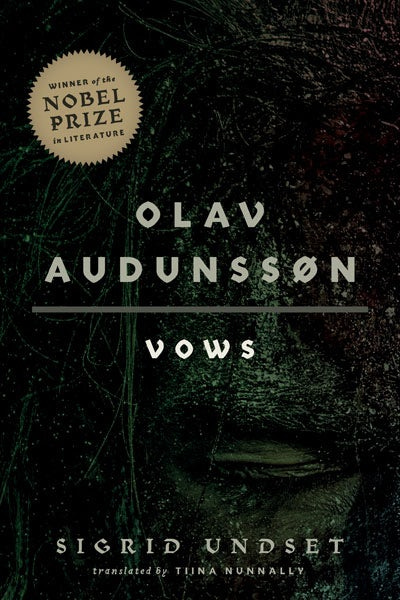
Olav Audunnson - This tetralogy is what Undset herself considered her greatest work, and it covers nearly the entire life of Olav Audunnson through the late 1200s to early 1300s as he grapples with his humanity and desire. Whereas Undset’s other medieval epic, Kristin Lavransdatter, features a character whose brokenness manifests as a burning fire within her, Olav’s brokenness throughout the novel feels like thick, impenetrable ice, seeping coldly into all his relationships. It has a darker tone than Kristin Lavransdatter, and features many passages with deep spiritual insight and impressive awareness of the male psyche, but I would recommend reading after Kristin Lavransdatter.
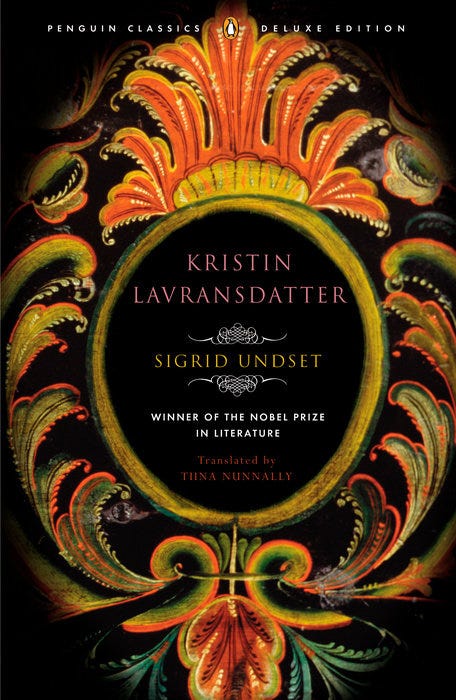
Kristin Lavransdatter - Considered her greatest masterpiece, this has to be my favorite Undset work. Following the life of a young girl from the age of seven until her death during the 1300s, its mastery of human emotion and subtext is sublime. Similar to Olav Audunnson, because of the epic scope of the novel, one gets a sense of God’s mysterious providence and the beauty of human redemption in a way otherwise impossible. It’s the greatest book I’ve ever read, and I’ll never tire of recommending it - see my (soon-to-be) nine part series breaking down and analyzing the entire novel.
Which of Undset’s novels have you read or on your to-be-read list?
I concur with your placement of Kristen and Olav at the top of your list. I've read them both twice and may very well read them again before I die, which is quite a testament to my appreciation of them since I'm 77. Of the other novels I've read only the Paul Selmer duology and Gunnar's Daughter. I was somewhat disappointed in the former, very enthusiastic about the latter. However, roughly 30 years separates my readings. I read Gunnar's Daughter in the early '90s and wrote about it in Caelum et Terra, a mostly unknown and long-gone Catholic magazine.
Years later I posted that review on my blog, and that's now 15 years ago. The last two sentences have proven to be true.
https://lightondarkwater.com/2010/07/03/sigrid-undset-gunnars-daughter/
I'll give you the links to my blog posts about the Selmer novels, which I read only recently. They are somewhat lengthy so I'll sum them up by saying that I suspect that Paul's bourgeois life is just not as interesting as Kristin's and Olav's, and that I also suspect that Undset herself may have realized this, which is why the story ends only partway through Paul's life.
https://lightondarkwater.com/2024/10/05/sigrid-undset-the-wild-orchid/
https://lightondarkwater.com/2024/11/19/sigrid-undset-the-burning-bush/
Ohhhh it's hard to choose between Olav and Kristin. I think in terms of her depth of research and ability to make medieval Norway come alive, I'd have to hand it to Kristin. There is so much richness there to come back to over and over. But, I think for the story, I actually ended up preferring Olav. I know that isn't typical. But there is something about the story of resisting grace and avoiding repentance, and all of the effects of that, she brilliantly captures. My husband and I read them together, pre-ordering Nunnally's translations as they came out, and we would just tear through them. We also both had the same experience of thinking a lot about the characters during the day and catching ourselves almost praying for them as if they were real people, because of how real and intense their pain seemed! It is simply astounding how she managed to capture and express the human experience and inner workings of the heart; on par with if not better than the Russians!
I really enjoyed her Jenny and the other short stories in the collection. I am waiting to see if Nunnally will translate Gunnar's Daughter before I read it :) Ida Elisabeth was sobering but also so well done. I think my mom has the Paul Selmer duology so I will get to that eventually. Have you read her hagiography on Catherine of Siena? I really enjoyed that.